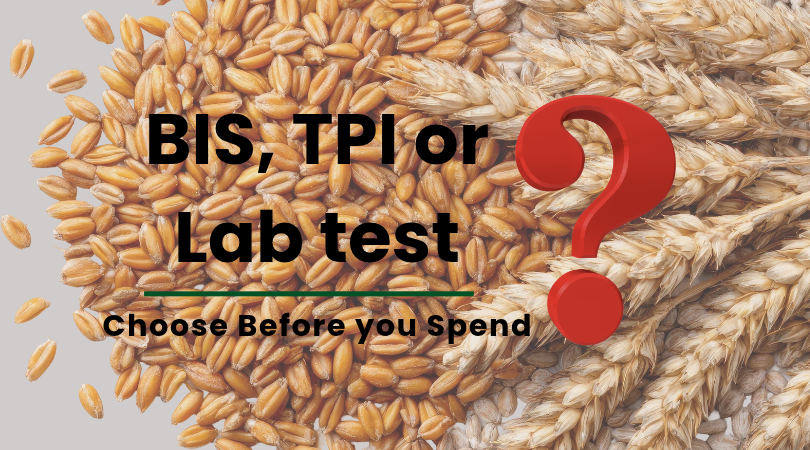
A buyer asks for your "quality documents" before approving your first bulk order. You send a lab report. He says, "This is for one sample. Where is the inspection report?" Another buyer asks, "Do you have a BIS licence?" A third wants to know if your lab is accredited.
Three buyers, three different questions. Many mill owners treat a laboratory report, a BIS licence and a third-party inspection report as if they were the same thing. They are not. Each proves something different, and choosing the wrong one means spending money while the real gap stays open.
Here is what each one does, when you need it, and how to decide without collecting certificates you don't need.
1. BIS Certification: Proving Conformity to an Indian Standard
The Bureau of Indian Standards is India's national standards body. It develops Indian Standards and runs product and system certification schemes. The ISI mark is linked to BIS product certification.
Not every milling product needs it. Whether certification is mandatory or voluntary depends on the product and on any government quality control order that applies. Many mills choose it voluntarily because it gives buyers a recognised basis to trust the product.
Before you apply, answer four questions:
- Which Indian Standard applies to my product?
- Does my product fall within the scope of that standard?
- Is certification mandatory under a quality control order?
- What testing and factory assessment will be required?
The path is: identify the standard, apply online, factory assessment, product sampling and testing at a recognised lab, and a licence once conformity is met.
💡Remember: BIS certification is not a logo to print on a packet. It represents conformity under a certification scheme, and BIS assesses your factory and tests your product to grant it.
2. Third-Party Inspection: An Independent Check Before the Buyer Accepts the Goods
Imagine a flour mill has finished an export order. The product is made, packed and ready to ship. The buyer, who may be in another country, wants proof that what is in the container matches the contract.
That is the job of a third-party inspection agency. It works independently of both seller and buyer. Depending on the agreed scope, it can verify:
- Product quality against the specification
- Quantity and weight
- Packaging and labelling
- Batch identification and lot numbers
- Loading and dispatch conditions
- Supporting documents
3. Laboratory Testing: Measuring What the Eye Cannot Confirm
Flour can look clean and uniform and still fail a quality or safety requirement. Moisture, ash, gluten, pesticide residues, heavy metals, aflatoxins and microbiological contamination cannot be judged by eye.
Depending on the product and specification, testing may include:
- Moisture content
- Ash and acid-insoluble ash
- Gluten or protein, where relevant
- Granulation and other physical properties
- Pesticide residues
- Toxins and heavy metals
- Microbiological parameters
💡Remember: A lab report is evidence about the sample tested. It does not certify the entire manufacturing process or the next consignment.
How to Choose: Start With the Business Need
Don't begin with "which certificate should I get?" Begin with "what does my business need to prove, and to whom?"
If your product is under a mandatory quality control order, you need BIS certification.
If your product is voluntary and you want domestic credibility, consider BIS certification.
If a buyer wants independent verification before dispatch, arrange third-party inspection.
If you need to know measured values, get laboratory testing.
Each one serves a different purpose. Pick based on need, not on how good a certificate looks on a company profile.
The Final Insight: Certification Opens a Door, Consistency Keeps It Open
Quality documents have value only when they reflect what actually happens on your shop floor. A mill with certificates but weak production controls will still face complaints and rejected shipments.
A mill that keeps reliable records, uses calibrated equipment, controls its process and verifies every lot is in a far stronger position. Its certificates, test reports and inspection findings carry real meaning because there is a system behind them.