
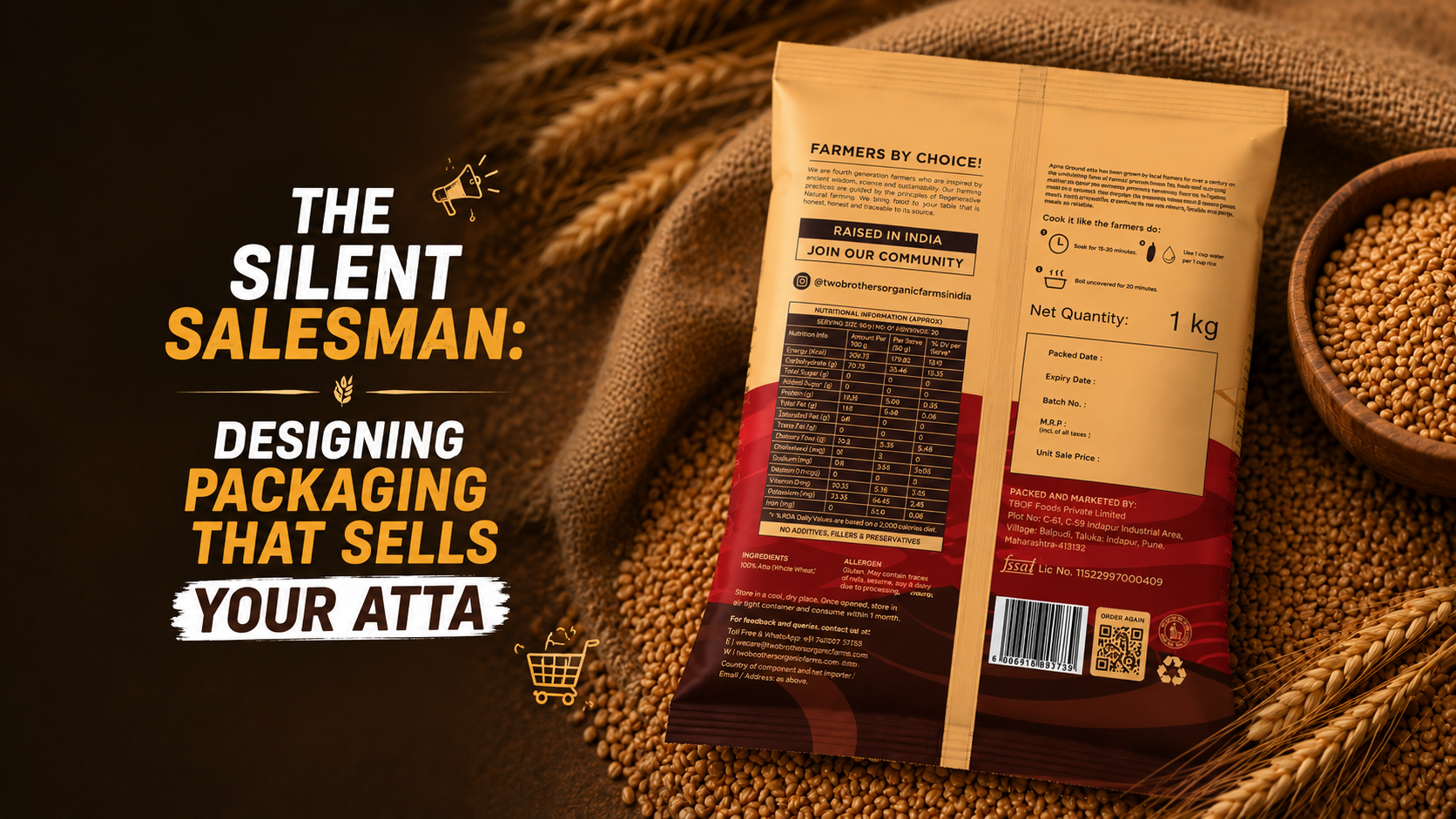
In the flour milling industry, many owners make a fatal mistake: they view packaging as nothing more than a container—a bag to hold the product. They think, “Bas bag hai, atta bharna hai” (It’s just a bag, just fill it).
But in a crowded retail market, your packaging is your Silent Salesman. It is the only thing speaking to the customer when you aren’t there. Before a customer ever tastes your rotis, they “taste” your brand with their eyes. If you want to move from being a local mill to a recognized national or regional brand, you have to stop thinking about “bags” and start thinking about “Visual Authority.”
1. The Power of First Impressions (The 3-Second Rule)
When a customer walks into a Kirana store or a modern supermarket, they are overwhelmed by choices. They don’t have the time to research your milling process or your wheat sourcing. Instead, they make a split-second judgment based entirely on your packaging.
- The Psychological Hook: Professional, clean packaging signals “Quality Control.” In the consumer’s mind, if the outside looks organized and premium, the inside must be hygienic and pure.
- The Budget Trap: If your bag looks “cheap” or the printing is blurry, customers instinctively assume the flour inside is dusty, contains impurities, or is low-grade—even if you are using the finest Sharbati wheat in the district.
- Color Psychology: Use colors that trigger hunger and trust. Creams and whites signal purity; golds and deep greens signal premium “farm-to-table” quality; reds and oranges can signal energy and freshness.
2. Clear Product Positioning: Don’t Make Them Work
Your packaging must answer three vital questions for the consumer in under three seconds. If they have to search for this information, you have lost the sale.
- What is it? Is it Chakki Fresh, Multigrain, Maida, or Sharbati? This should be the largest text after your brand name.
- Is it for me? Your design should communicate your price point. A minimalist, matte-finish bag signals “Premium/Health-focused,” while a bright, glossy bag with bold “Value” claims signals “Economy/Daily Use.”
- What is the “Magic” benefit? Don’t just say “Atta.” Say “Phulki Jaisi Naram Roti” (Rotis soft as air) or “High Fiber for Digestion.” Give them a reason to choose you over the giant national brands.
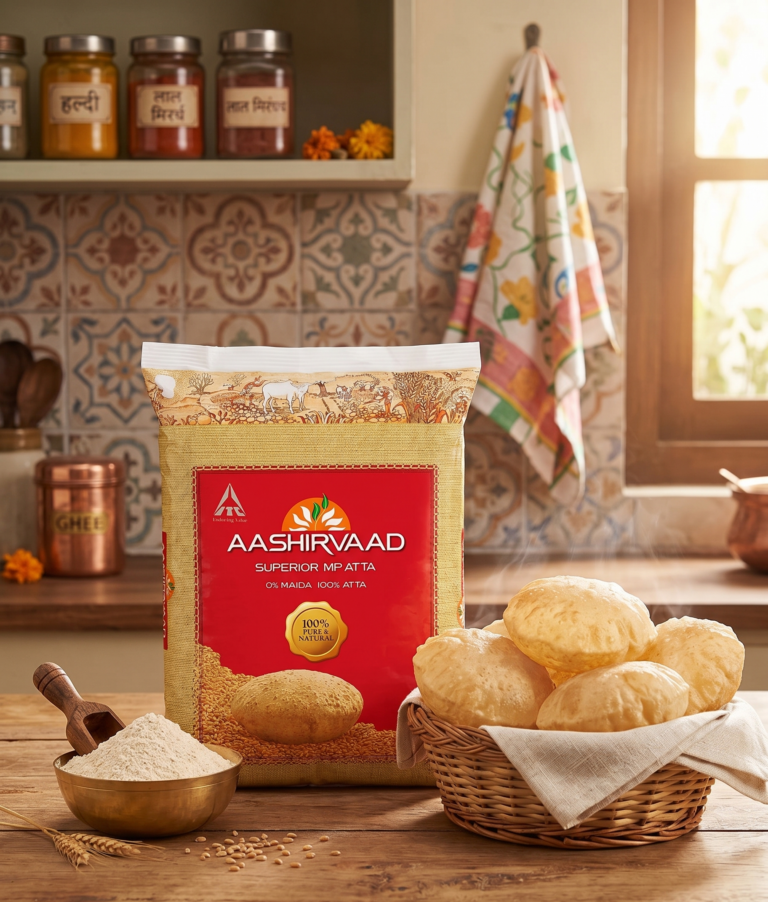
Pro Tip: Use bold, high-contrast fonts. Store lighting is often poor; if a customer has to squint to read your brand name or expiry date, they will reach for the competitor’s bag instead.
3. The “Window” of Trust
In the Indian market, “Seeing is Believing.” While national brands can afford to have fully opaque bags because of their massive ad budgets, a new brand needs to prove itself instantly.
- Transparency as Truth: A small, well-placed transparent window allows the customer to see the actual color and texture of the flour.
- The Psychological Result: It removes the “fear of the unknown.” When a customer sees that the atta is clean, white, and free of visible bran specs or lumps, their trust in your brand doubles before they even reach the billing counter.
- Placement Matters: Place the window on the lower half or the side so it doesn’t interfere with your branding and logo at the top.
4. The Size Strategy: Building the Loyalty Ladder
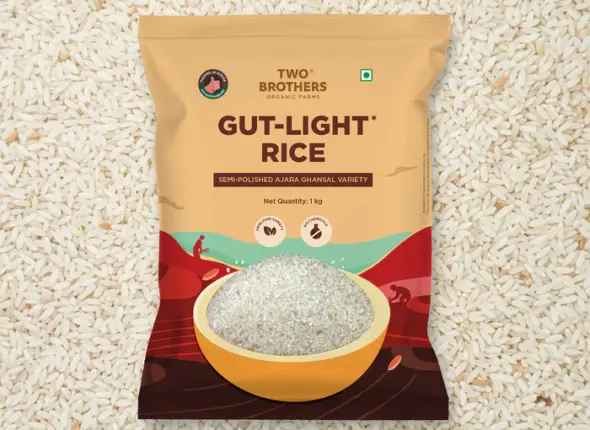
In the flour business, consumer behavior varies wildly based on family size and income. Offering only one size is like leaving money on the table. You need a “Ladder Strategy”:
- 1 kg (The “Trial” Pack): Think of this as your business card. It’s for the skeptic who wants to test your quality without risking much money.
- 2 kg (The “Modern Family” Pack): Increasingly popular in urban areas for small families or those who want fresh flour but don’t have large storage spaces.
- 5 kg (The “Standard” Pack): The absolute sweet spot for the average Indian household. This is where your highest volume usually sits.
- 10 kg+ (The “Loyalty” Pack): For large families and bulk users. This pack should emphasize “Value” and “Savings per KG.”
5. Material & Durability: The “Hand-Feel” of Quality
Branding isn’t just about what people see; it’s about what they feel.
- Sturdiness: If a bag feels flimsy or tears easily, the customer immediately worries about moisture getting in or pests attacking the flour.
- Finish: Consider a matte finish for a premium look or a high-gloss finish for a vibrant, mass-market look.
- Hygiene Sealing: Ensure your heat-sealing is perfect. A leaking bag on a retail shelf doesn’t just waste a product—it ruins the brand’s reputation for everyone who walks past it.
6. Regulatory Compliance (The “Non-Negotiables”)
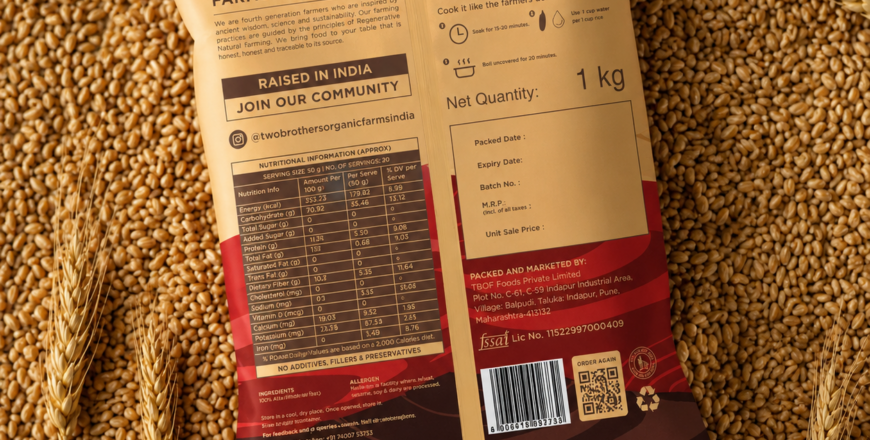
Nothing kills a brand faster than a legal hurdle. Ensure your packaging design leaves clear, dedicated space for:
- FSSAI Logo and License Number: This is the primary mark of trust in India.
- Nutritional Table: Today’s mothers are health-conscious; they want to see the protein and fiber content.
- Batch Number, MRP, and PKD Date: Use a clear, white “Inkjet Area” so this info is readable and doesn’t overlap your beautiful design.
The Final Insight: Investment vs. Expense
Many millers try to save 50 paise per bag by opting for lower-quality printing or thinner plastic. This is a classic “Penny Wise, Pound Foolish” mistake.
Good atta sells once, but good packaging helps it sell again.
Your product quality brings the customer back for a second purchase, but your packaging is what earns you the privilege of that first trial. In a competitive market, you cannot afford to be invisible. Dress your product for the success you want it to achieve.
Key Takeaway: Treat your packaging as your most important marketing employee. It works 24 hours a day, stands on every shelf, and speaks directly to your customer. Make sure it has something good to say.