
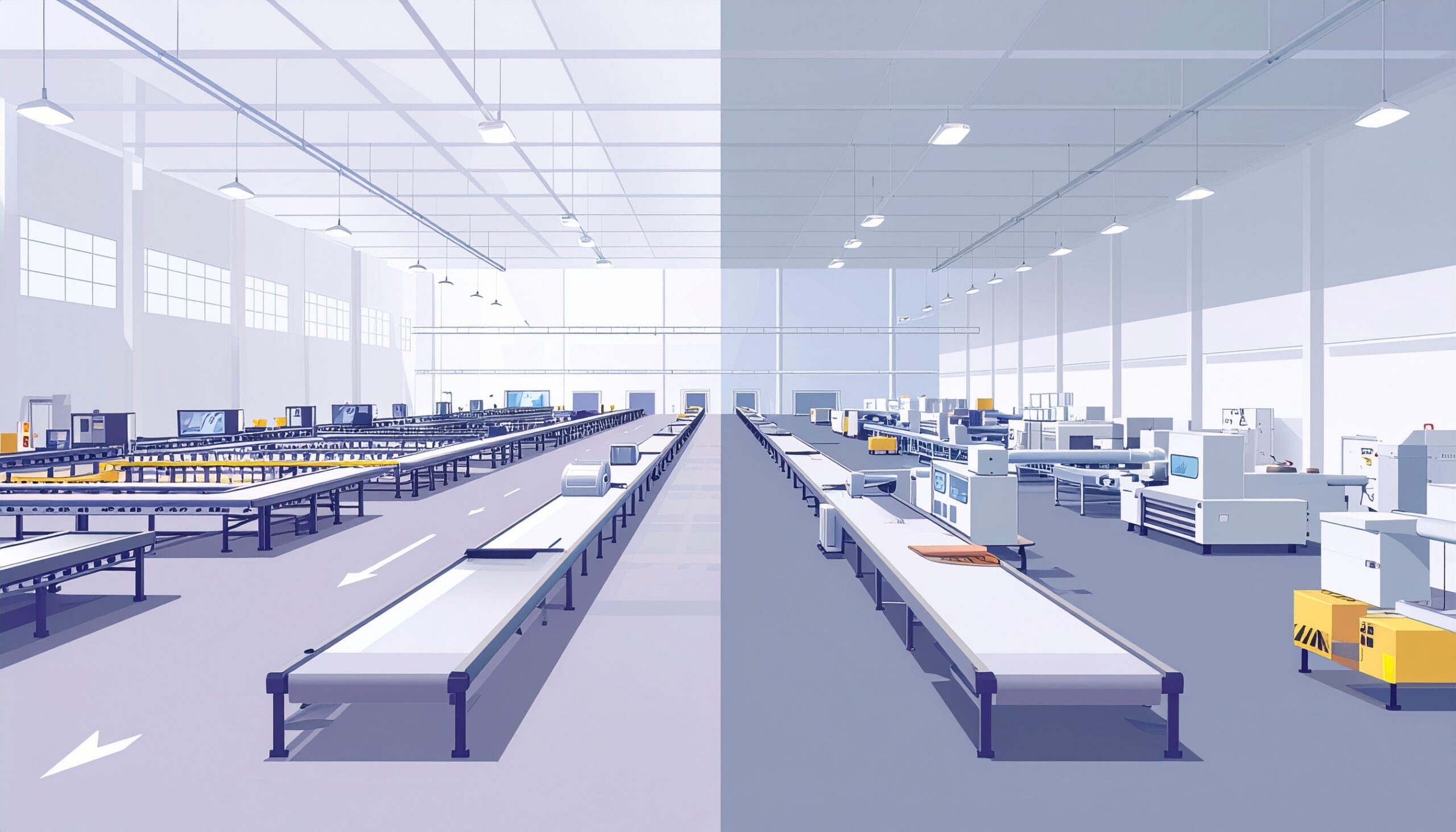
There is a common misconception in industrial management that the path to higher production lies in the acquisition of more equipment. If the plant isn’t meeting its targets, the instinctive reaction is often to “add another machine.” However, a plant floor crowded with high-tech equipment does not guarantee a high-performing operation. In many cases, adding a new machine to an imbalanced line is like putting a more powerful engine into a car with a broken transmission—you might have more raw power, but you aren’t going anywhere faster. Real efficiency and product quality are not determined by how many machines you have, but by how well the process flows between them.
Defining the “Flow” over the “Unit”
In an industrial context, process flow is the synchronized movement of material, energy, and information through a sequence of stages to create value. Machine count, on the other hand, is simply a measure of localized capacity.
- Component-Level Thinking: Focuses on the performance of a single machine (e.g., “Is the roller mill running at its rated capacity?”).
- System-Level Thinking: Focuses on the relationship between machines (e.g., “Is the sifter capable of handling the increased output from the roller mill without losing separation efficiency?”).
The goal of a master operator or engineer is to ensure that the “pulse” of the plant is steady. When you think in components, you see a collection of parts; when you think in systems, you see a river.
The Bottleneck Reality: Why More Machines Can Fail
The most critical lesson in process engineering is the Theory of Constraints: a system is only as fast as its slowest point. Adding machines to non-bottleneck areas is a waste of capital and floor space.
Why Machine Count Alone Fails:
- The Upstream Pile-up: If you add a high-capacity mixer but keep the same slow raw-material intake system, the mixer will spend half its time idle, waiting for a load.
- The Downstream Clog: If you increase milling capacity but don’t upgrade the pneumatic transport or packaging lines, you simply create a massive backlog that forces the entire plant to shut down once the intermediate bins are full.
- Synchronization Loss: Each new machine adds a “node” that must be synchronized. If the speeds don’t match perfectly, you create “surging,” which is the enemy of quality.
Key Reasons Process Flow Matters More Than Capacity
1. Imbalanced Capacities Cause Instability
When one machine is significantly faster than the next, the material “slugs.” This lack of steady-state flow leads to inconsistent product density, temperature spikes, and erratic moisture levels. A smaller plant with perfectly balanced machines will often out-produce a larger, imbalanced plant because it never has to stop and start.
2. Smooth Flow Improves Quality and Control
Quality issues often arise during transitions—when material stops moving, settles, or is redirected. A smooth, continuous flow ensures that every particle of material receives the same treatment time and intensity.
- Consistency: Uniform residence time leads to uniform product.
- Operator Control: It is much easier for an operator to fine-tune a system that is in a “steady state” than one that is constantly fluctuating.
3. Waste and Energy Reduction
Every time material is stopped, lifted, or stored in a buffer bin, energy is consumed. Poorly designed flow requires more conveyors, more air pressure, and more “rework” loops.
- Energy Efficiency: A direct, gravity-assisted flow is far cheaper to run than a complex, winding path requiring multiple mechanical lifts.
- Wear and Tear: Frequent stopping and starting of heavy motors (due to imbalanced flow) causes significantly more mechanical wear than continuous operation.
Real-World Plant Observations: The “Crowded Floor” Syndrome
I have seen plants where management added a second sifter to solve a capacity issue, only to find that the total output didn’t budge. Why? Because the bottleneck wasn’t sifting surface area; it was the diameter of the spouting leading into the sifter. The physical layout restricted the flow, making the extra machine an expensive decoration.
The Impact of Layout and Sequencing:
- Synchronization: In a well-designed flow, the output of Machine A is the ideal input for Machine B.
- Feedback Loops: In systems thinking, we recognize that Machine B sends a “signal” back to Machine A. If Machine B starts to run hot, Machine A must automatically throttle back. If these machines aren’t viewed as a single unit, the “handshake” fails.
Practical Tips for Evaluating and Improving Flow
If you suspect your plant is “machine-heavy but flow-poor,” consider these steps:
- Map the “Value Stream”: Don’t look at the machines; follow a single kilogram of raw material from the intake to the loading dock. Where does it sit still? Where does it change direction abruptly?
- Audit the Connections: Often, the bottleneck isn’t the machine; it’s the spouting, the conveyors, or the air-locks between them.
- Measure “First Pass Yield”: If you have a high machine count but are doing a lot of rework, your flow is likely turbulent, causing damage to the product.
- Simplify the Path: Every elbow in a pipe and every unnecessary elevator is a point of friction. The most efficient plants usually have the simplest visual layouts.
Conclusion: The Mastery of Motion
In the final analysis, a manufacturing plant is not a warehouse for machinery; it is a machine itself. The individual components—the grinders, the mixers, the sifters—are merely the organs of a larger body. If the circulatory system (the flow) is blocked or inefficient, the strength of the individual organs doesn’t matter.
Mastering industrial operations requires moving past the “more is better” mindset. By prioritizing synchronization, balancing capacities, and respecting the dependencies between upstream and downstream stages, you create a system that is resilient and easy to manage. Remember: a well-designed flow beats a crowded machine floor every time.