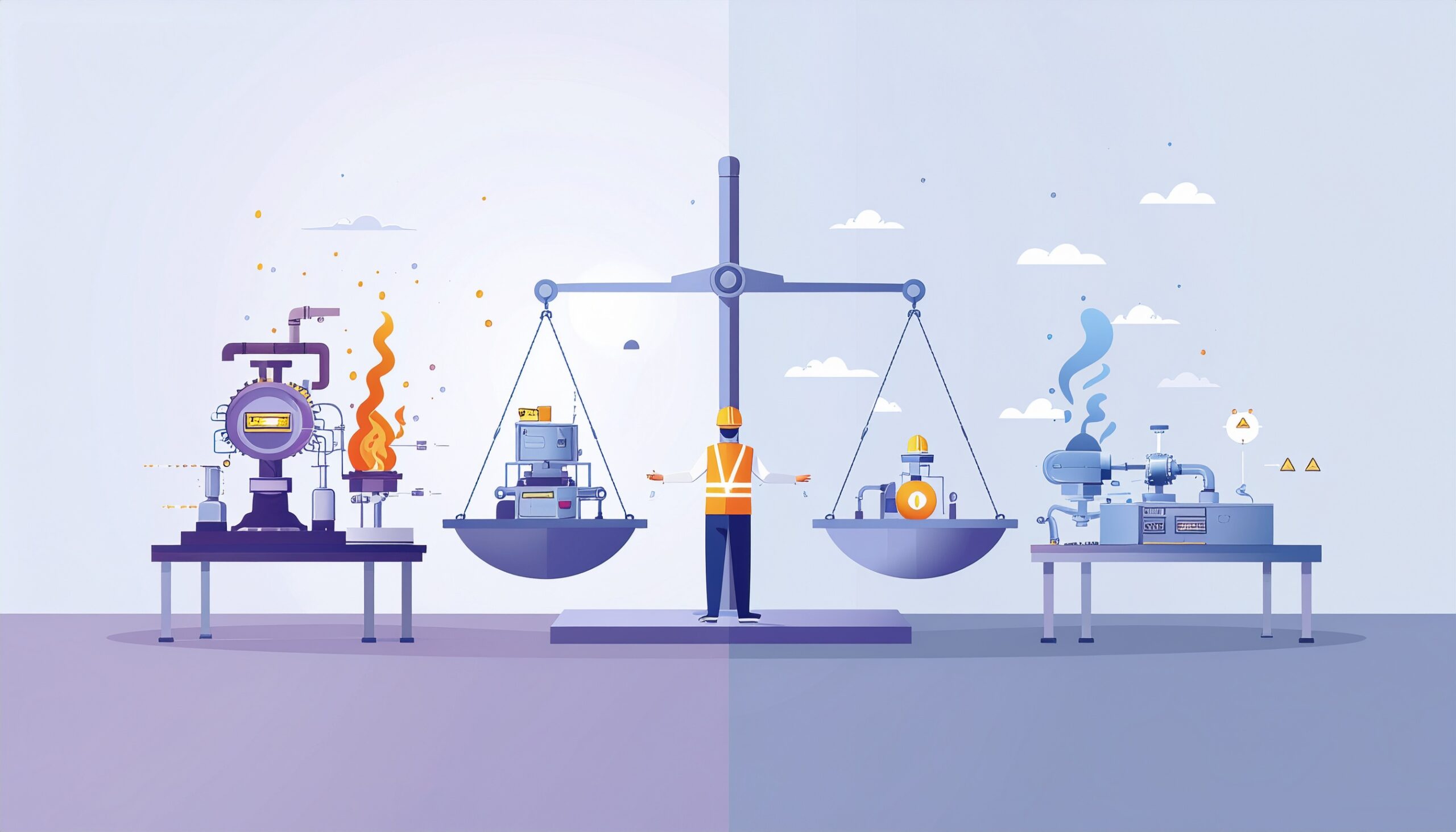
In a perfect world, a manufacturing plant would run at 100% capacity with zero defects, minimal energy consumption, and no downtime. In reality, the production floor is a theater of constant compromise. Plant operators and production managers often find themselves caught between two powerful, competing forces: the drive for efficiency—dictated by throughput targets and cost-per-unit metrics—and the demand for quality—defined by strict product specifications and customer expectations. When these two priorities clash, it is the operator on the floor who must navigate the trade-offs, making split-second decisions that determine the day’s success or failure.
Understanding these trade-offs is essential for anyone looking to optimize a sustainable operation that doesn’t burn out its equipment or its reputation.
Defining the Conflict: Throughput vs. Excellence
To manage the conflict, we must first understand what is at stake on both sides of the equation.
- Efficiency is often viewed through the lens of volume. It includes maximizing throughput (units per hour), increasing yield (output vs. raw material input), reducing energy consumption, and minimizing scheduled or unscheduled downtime.
- Quality is about adherence to a standard. It encompasses product consistency, physical and chemical specifications, sensory attributes (texture, color, taste), and, most importantly, food or consumer safety.
The tension arises because the “envelope” of peak quality often narrows as the speed of production increases. Pushing a system to its mechanical or thermal limits frequently introduces variability that compromises the final product.
Key Trade-offs Operators Face Daily
In real-world plant conditions, operators are rarely choosing between “good” and “bad.” Instead, they are choosing between two “goods” that cannot fully coexist under current constraints.
1. Higher Throughput vs. Consistent Quality
As production rates increase, “residence time”—the duration a product spends in a specific process like heating, mixing, or milling—decreases.
- The Conflict: If a dryer is pushed to handle 20% more volume, the product has less time to reach the target moisture level.
- The Result: Operators may have to increase temperatures to compensate, potentially “case-hardening” the product or scorching it, leading to a loss of texture or nutritional value.
2. Reduced Downtime vs. Proper Maintenance
Efficiency metrics often penalize downtime, putting pressure on operators to keep the line moving at all costs.
- The Conflict: Deep cleaning or preventative maintenance (PM) requires stopping the line. When production is behind schedule, these tasks are often shortened or deferred.
- The Result: Short-cutting a “Clean-in-Place” (CIP) cycle might save an hour of production time, but it significantly increases the risk of microbial contamination or flavor carryover between batches.
3. Energy Savings vs. Process Stability
With rising utility costs, plants are under pressure to reduce energy use.
- The Conflict: Some stability-enhancing equipment, like recirculating heaters or high-power dust aspiration systems, consumes significant energy.
- The Result: Reducing fan speeds or heater outputs to save energy can lead to condensation in pipes or uneven temperature zones, causing product clumping or spoilage.
4. Automation Speed vs. Human Judgment
Modern plants rely on automated sensors to make corrections, but these systems have limits.
- The Conflict: High-speed automation can react faster than a human, but it lacks “context.” It may try to correct a raw material deviation by over-adjusting a setting, leading to a “yo-yo” effect in quality.
- The Result: Operators often have to slow the line down to “manual” speeds to stabilize a sensitive process, sacrificing efficiency to regain control over quality.
Real Plant Challenges: The Human Element
Beyond the machinery, several environmental factors complicate these trade-offs.
- Raw Material Inconsistency: When a low-quality batch of raw materials arrives, the “ideal” efficiency settings no longer work. An operator must choose whether to slow down to maintain quality or keep the speed up and risk a high “reject” rate.
- Shift-Based Decision Making: Performance is often tracked by shift. A morning shift might prioritize throughput to meet a daily quota, leaving the afternoon shift to deal with the resulting equipment wear or quality “drift.”
- Time Pressure: When a shipment is waiting at the loading dock, the pressure to “just get it out the door” can lead to a subconscious lowering of quality standards.
Best Practices for Balancing the Scales
The goal is not to eliminate trade-offs—which is impossible—but to manage them through a structured approach.
- Define “Non-Negotiables”: Clearly establish which quality parameters (e.g., safety, weight accuracy) can never be sacrificed for efficiency.
- Dynamic Setpoints: Move away from “fixed” production speeds. Teach operators to adjust throughput based on the variability of raw materials.
- Integrated KPIs: Instead of tracking efficiency and quality separately, use “First Pass Yield” (FPY)—a metric that only counts units that meet quality standards on the first try.
- Cross-Functional Communication: Ensure that the maintenance, quality, and production teams meet daily to discuss where the “pinch points” are occurring.
Conclusion: The Path to Sustainable Operations
The conflict between efficiency and quality is a permanent feature of industrial life. However, viewing them as a zero-sum game is a mistake. An operation that focuses solely on efficiency will eventually fail due to high waste and lost customer trust. Conversely, an operation that ignores efficiency will become too expensive to remain competitive.
Sustainable success lies in finding the “sweet spot” where the process is stable enough to be efficient. This requires empowering operators with the authority to prioritize quality when the system is under stress. Ultimately, a plant’s true capacity is not determined by how fast it can run, but by how fast it can run while still producing a perfect product.